
Detailed Vastu Report of a House: How to Read the Full Report

By Deesha · Reviewed by Editor, VastuScan
20 October 2026 · 4 min read
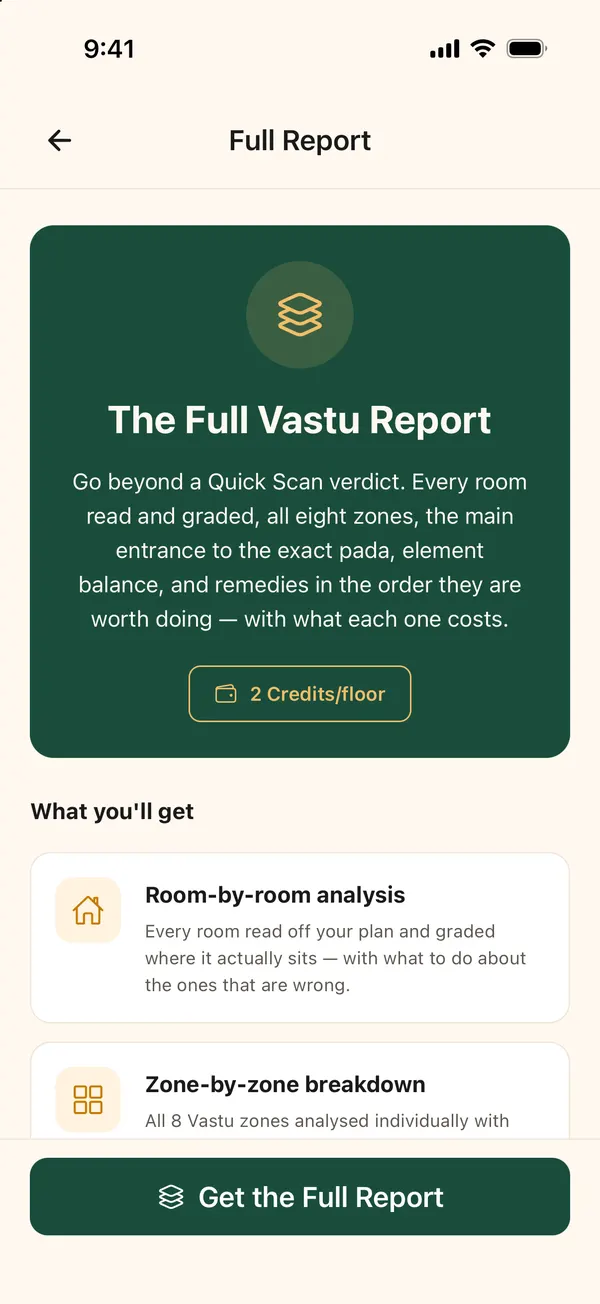
The Full Report is VastuScan's most detailed reading of a floor plan. It grades every room across 16 directions, summed up in 8 zones, reads the main door to its exact pada, and ranks the remedies by how much they are worth doing. This guide shows how to run one and how to read it, using a made-up sample flat.
When the Full Report is worth it
A Quick Scan answers "is this home good, and what are its main problems?". The Full Report is for when you are close to a decision, or already living there and want a plan of what to fix, in what order, and at what cost. It uses 2 credits per floor, and it has no free tier.
Step 1: Name the property
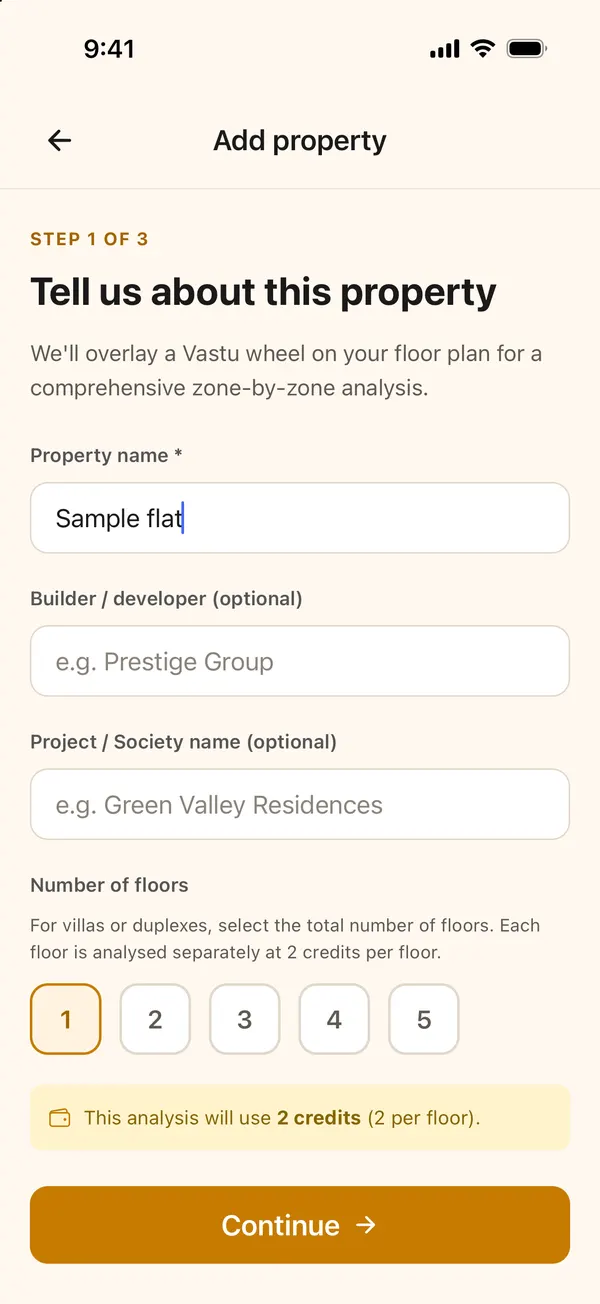
Tap Get the Full Report, then give the property a name you will recognise. The builder and project are optional. For a duplex or villa, choose the number of floors: each floor is analysed separately, and the screen shows how many credits it will use.
Step 2: Upload and crop the plan
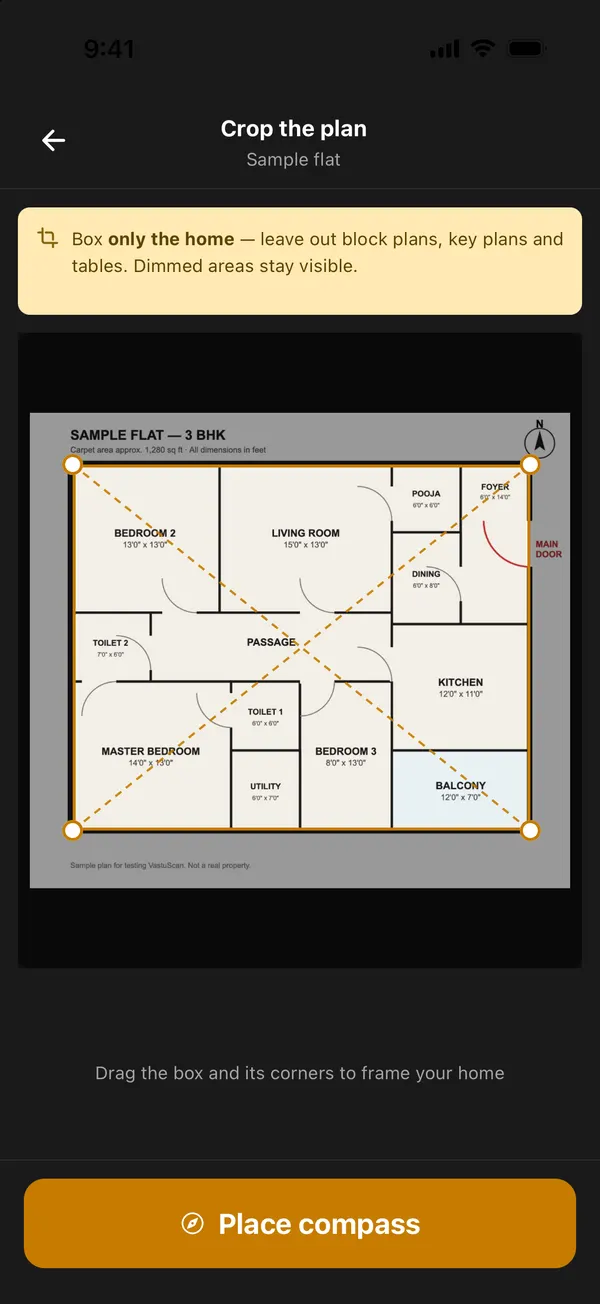
Upload the plan exactly as for a Quick Scan: one floor per image, every room name readable. Then drag the crop box onto the outer walls of the home, leaving out the title, key plan and tables. The centre of the home is worked out from this box, so take care here.
Step 3: Set the centre and north
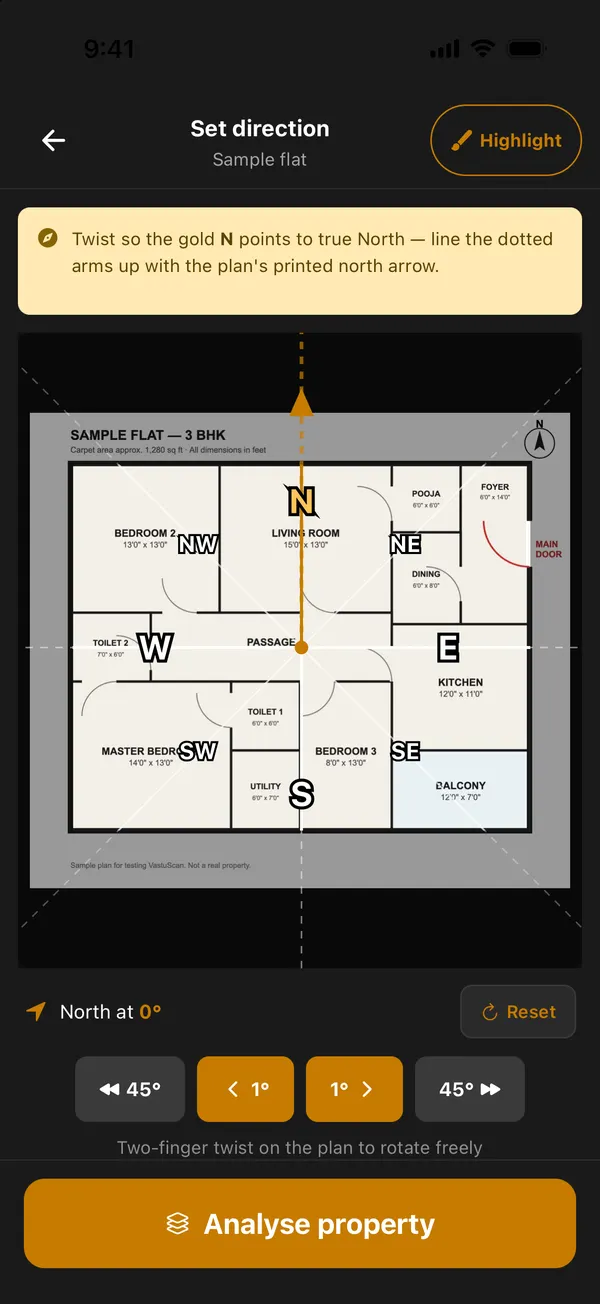
Tap Place compass, check that the compass sits on the centre of the home, and lock it. Then twist the compass until the gold N matches the plan's printed north arrow (the 1° and 45° buttons help). Tap Analyse property.
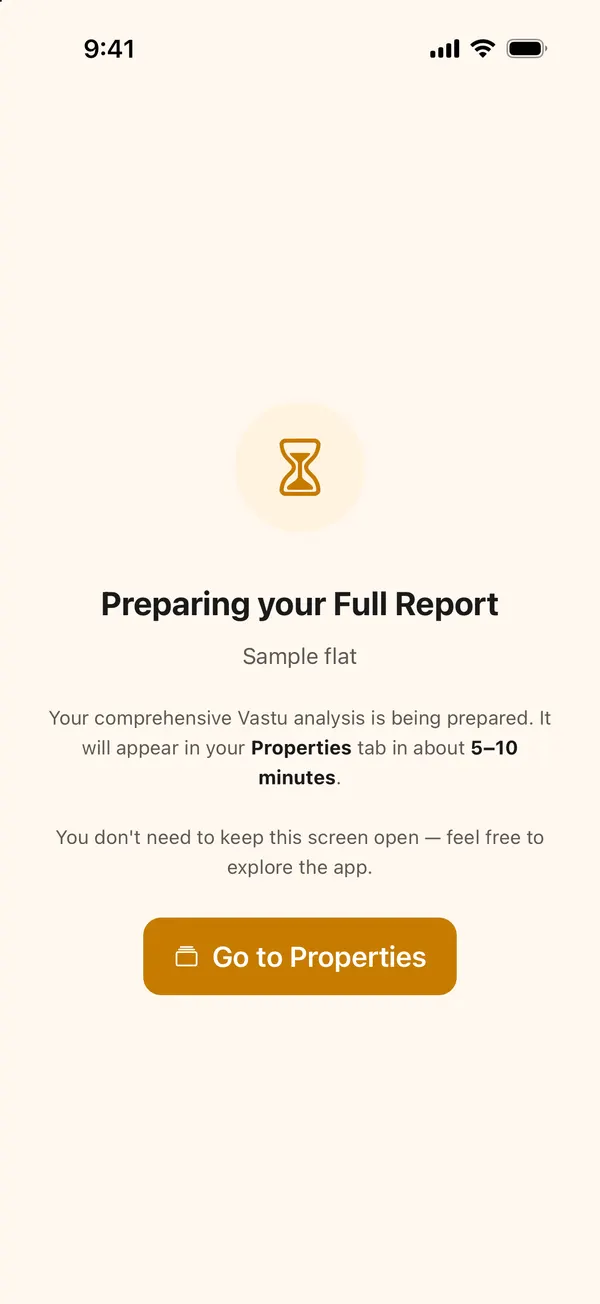
Step 4: Wait for the report
The Full Report takes about 5 to 10 minutes. You don't need to keep the screen open: it appears in the Properties tab when it is ready.
How to read the report
The summary
At the top: the Vastu score, the verdict, the facing, and the score after remedies, with a line on what the remedies involve and roughly what they cost. The sample flat scored 61, a Caution, rising to 76 with remedies and no demolition.
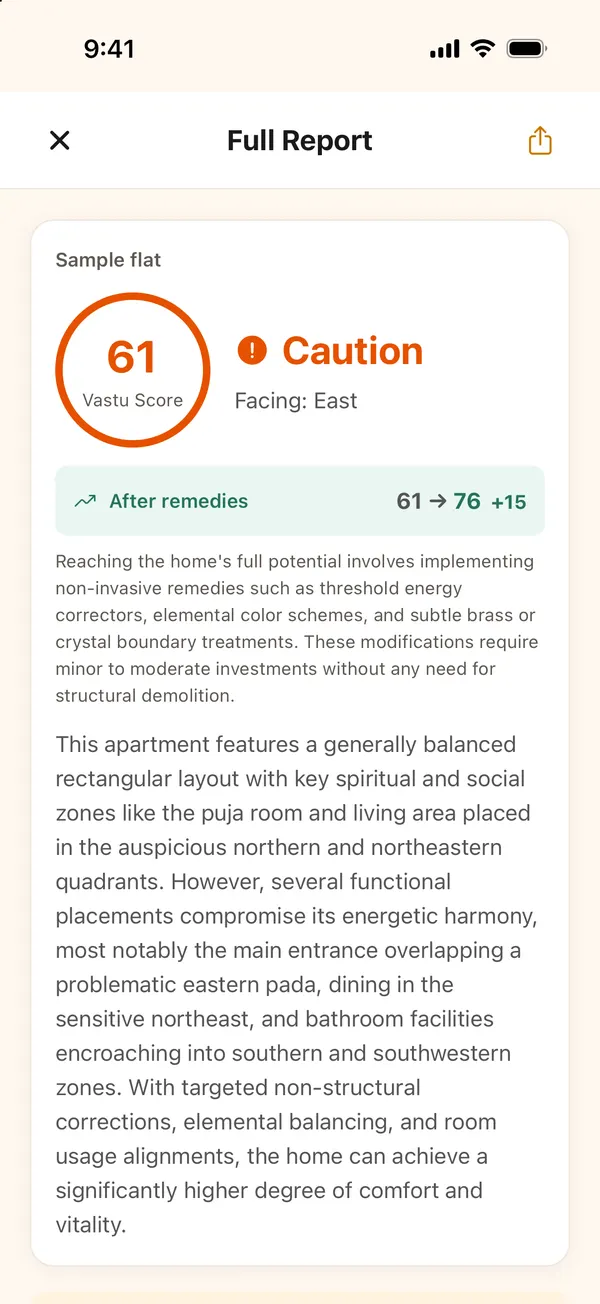
| Verdict | Score | Meaning |
|---|---|---|
| Good | 75–100 | No critical defects; any problems are minor or remediable. |
| Caution | 41–74 | One or more serious problems; remedies help but some trade-offs stay. |
| Avoid | 0–40 | A Critical defect (which caps a home at 40), or many serious problems. |
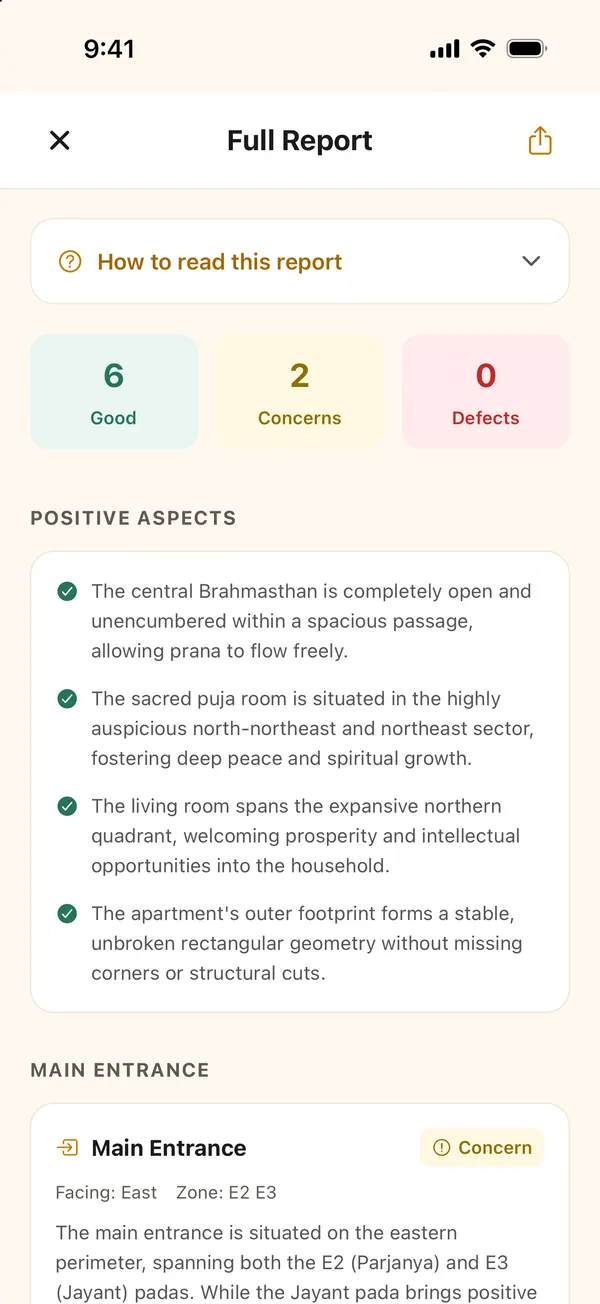
Next come three counts (good points, concerns and defects), the positive aspects of the home, and the main entrance. The entrance is read by pada: the sample flat's door spans two padas on the east side, one favourable and one not, which is why it is marked Concern even though "east-facing" sounds good.
The centre and the rooms
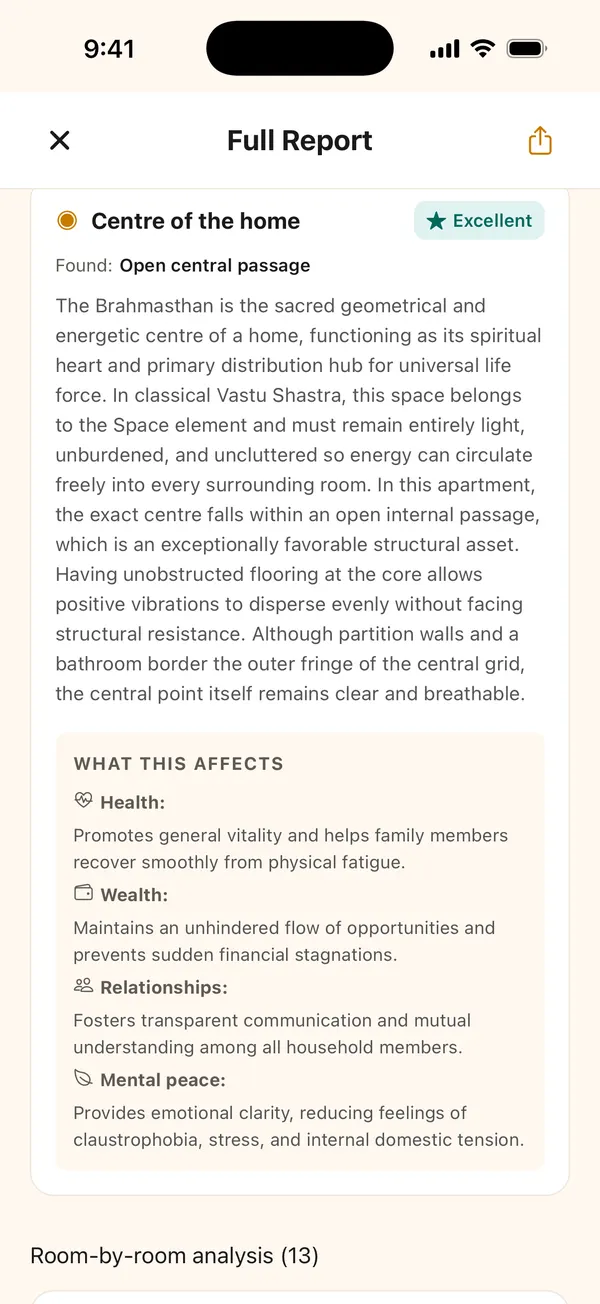
The centre of the home is graded on its own; an open passage at the centre, as here, is Excellent. Each room then gets a card: its zone, its ideal direction, a short explanation, what the placement is traditionally said to affect, colours that suit it, and a remedy where one helps.
The zones
The report then goes zone by zone, listing every room that falls in each one with its grade. A room our rules have no ruling for in that position is marked Not assessed rather than given a guessed grade.
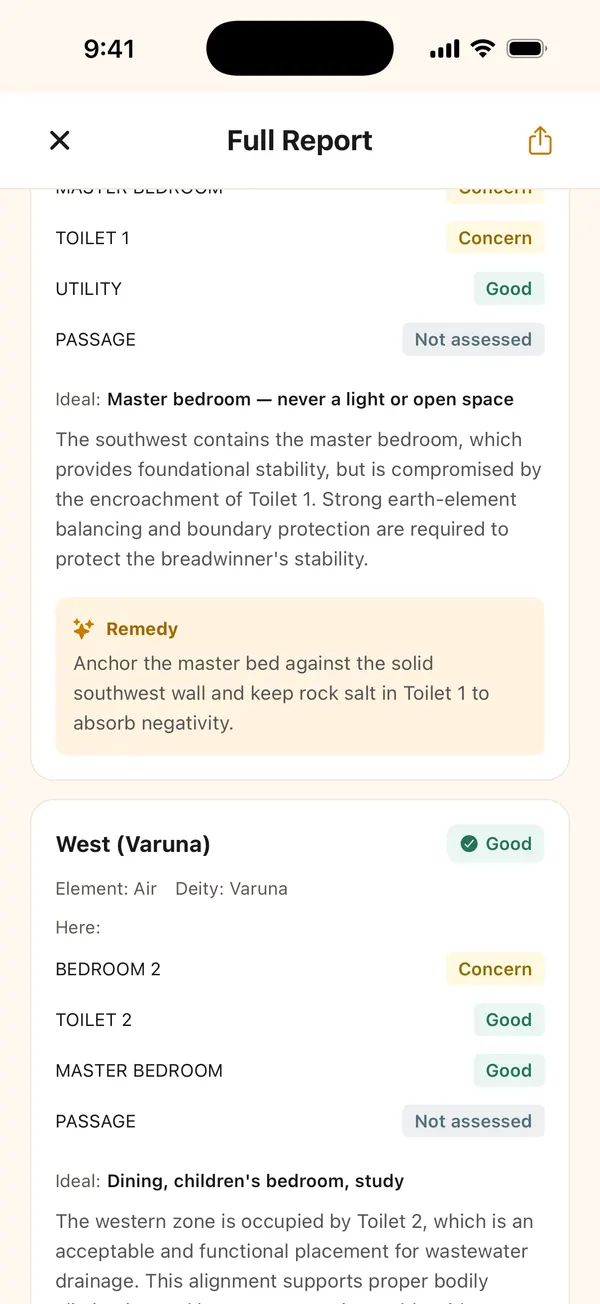
Defect checks and how the score was worked out
The classical defect checks go through the placements our rules treat as the most serious, such as a toilet, kitchen or staircase in the north-east, or a staircase at the centre. The sample flat cleared all 13. Below them, How this score was calculated shows each room's score, so you can see which rooms pulled the total down.
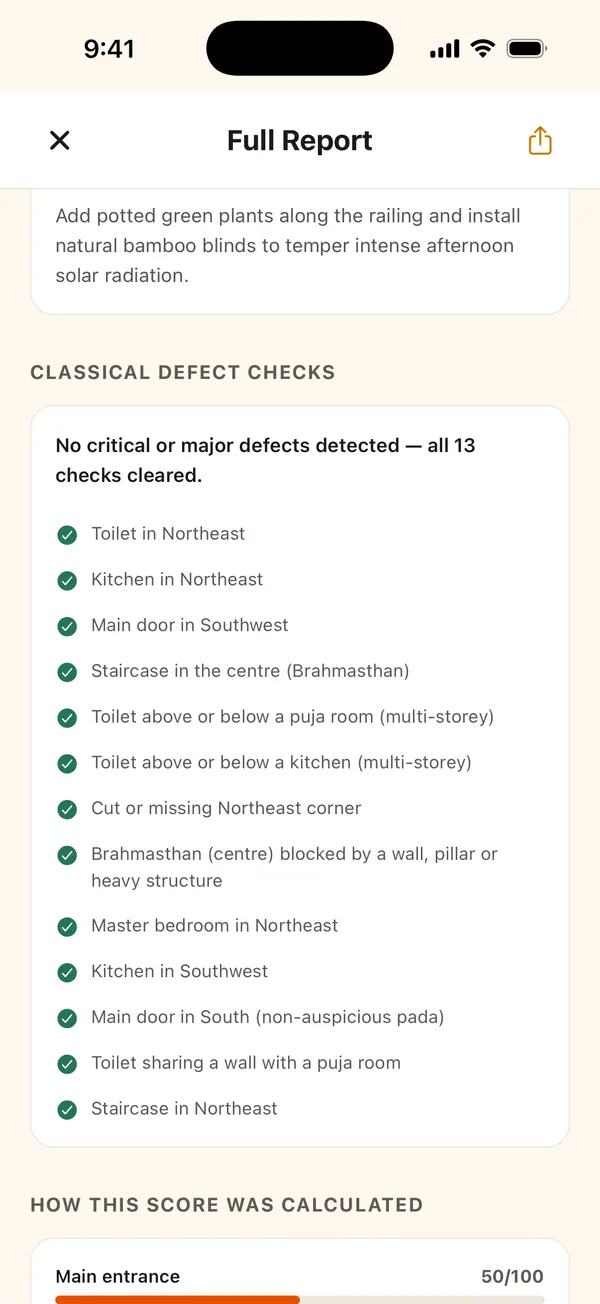
Element balance and priority remedies
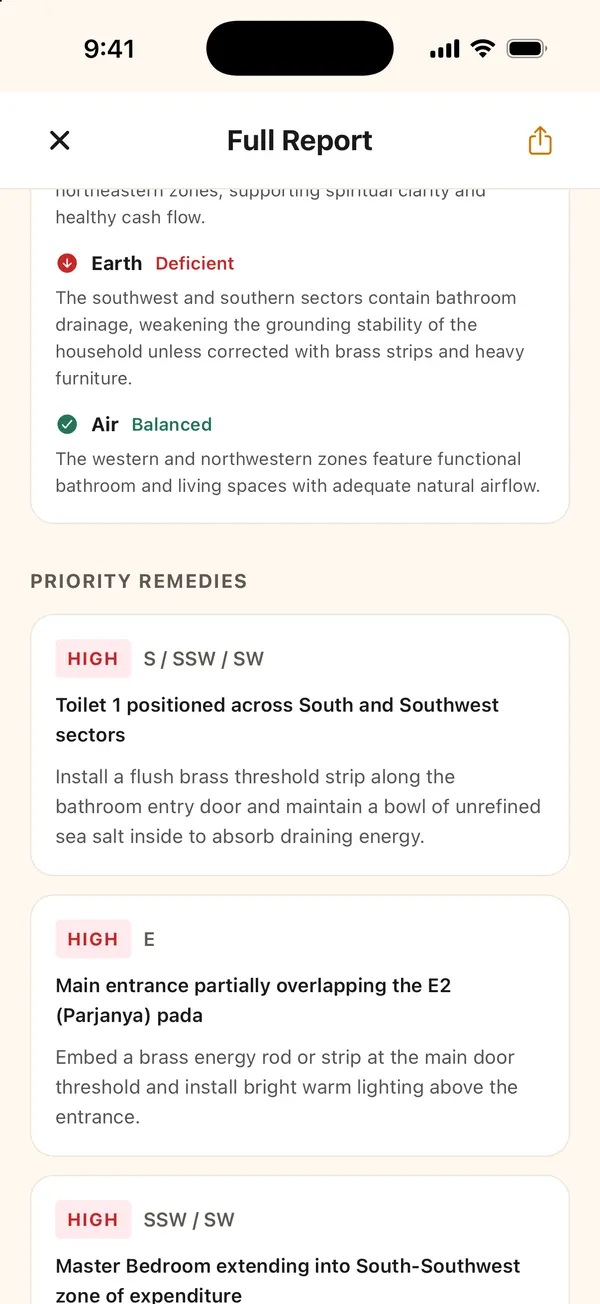
Element balance shows which of the five elements is well placed and which is deficient. Priority remedies is the part to act on: each remedy is marked High or Medium, names the zone, and says what to do. Start with the High ones.
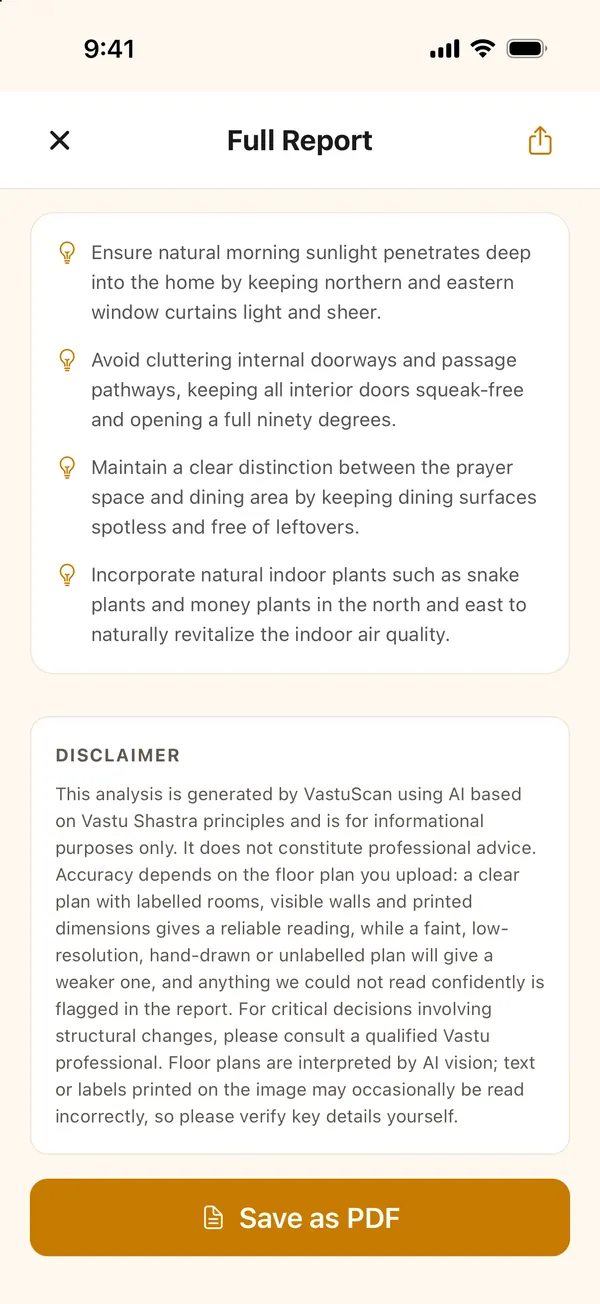
At the end come general tips, the disclaimer, and Save as PDF to share the report with family or your architect.
Read it in this order
- The verdict, then the score after remedies.
- The defect checks: any Critical defect matters more than everything else.
- The main entrance and its pada.
- The High priority remedies, and what they cost.
The grades in every section come from VastuScan's Vastu rules, and How VastuScan checks a home explains the scoring and its limits.
Questions people ask
What does the Full Report add over a Quick Scan?
Every room graded across 16 directions, summed up in 8 zones with what is in each, the main door read to its exact pada, the balance of the five elements, the classical defect checks, and remedies ranked by priority with their cost. A Quick Scan gives the verdict and the main issues.
How long does it take, and how much does it cost?
It takes about 5 to 10 minutes and uses 2 credits per floor. You don't need to keep the screen open: the report appears in the Properties tab when it is ready. The Full Report has no free tier.
Why can the Full Report's score differ from a Quick Scan of the same plan?
It reads the plan in more detail, for example the door's exact pada rather than its zone, so a room near a boundary can be graded differently. On our sample flat both gave 61; on another plan they may differ by a few points.
Written with AI by Deesha, VastuScan’s AI Vastu guide, and checked against VastuScan’s published Vastu rules. Vastu Shastra is a traditional system; this is guidance, not architectural, structural or financial advice, and no outcome is promised.
Read next
Vastu apps & tools
How to Use Compass Check: Vastu Without a Floor Plan, Step by Step
No floor plan? Compass Check maps each room with your phone's compass. A step-by-step guide with real screenshots, from standing at the centre to the report.
Vastu apps & tools
How to Use Quick Scan: Check a Floor Plan in VastuScan, Step by Step
A step-by-step guide to VastuScan's Quick Scan, with real screenshots: name the home, upload the plan, crop it, set the centre and north, and read the report.
Vastu apps & tools
How VastuScan Checks a Home: Our Rules, Our Scoring, and What We Can't See
How VastuScan turns a floor plan into a Vastu score: who decides the directions, how rooms are graded and scored, how remedies are costed, and its limits.